
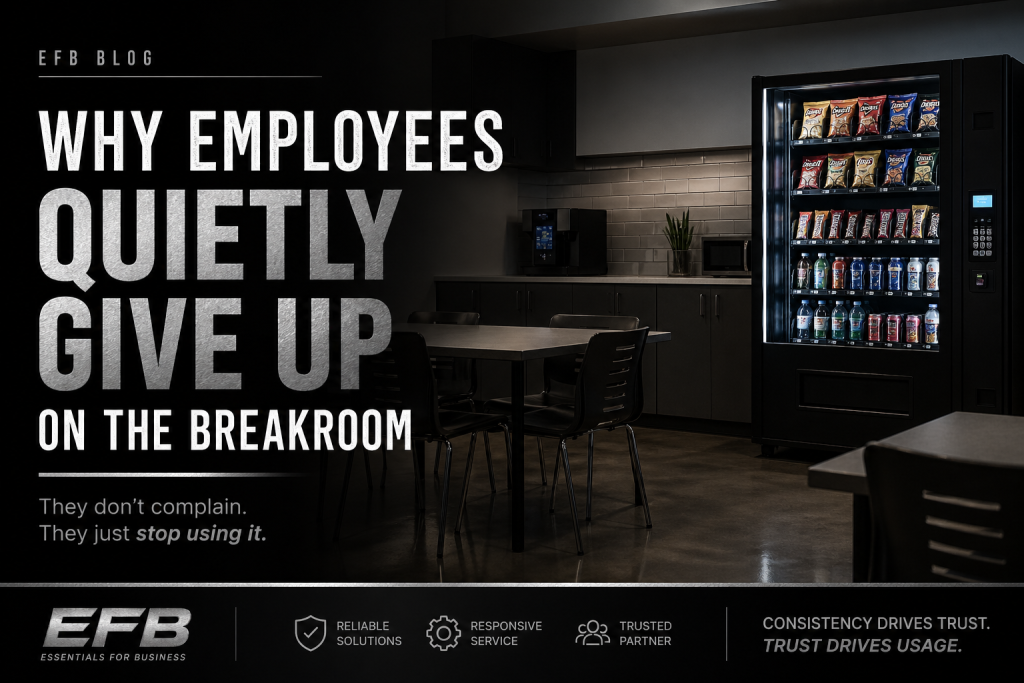
Most breakroom problems aren’t visible at first.
Machines are still there. Products are still stocked. Everything appears to be working.
But over time, something starts to change—usage drops.
Not because of one major issue, but because of small, repeated inconsistencies that slowly break trust.
It Doesn’t Happen All at Once
Most breakrooms don’t fail overnight.
They fade.
At first, it’s small things:
- A favorite item is always out of stock
- A machine has an issue that takes too long to fix
- The selection starts to feel repetitive
Individually, none of it feels like a big deal.
But over time, it adds up.
People Don’t Report Problems—They Adapt
In theory, employees should report issues.
In reality, they don’t.
They:
- Bring food from home
- Leave the building instead
- Skip the breakroom altogether
Once that habit changes, it’s hard to bring them back—even if the problem gets fixed later.
“Good Enough” Doesn’t Keep People Coming Back
A breakroom that’s just okay doesn’t hold attention.
If it’s not reliable, people won’t risk wasting time or money on it.
That means:
- Inconsistent stocking leads to lost trust
- Slow service responses reduce usage
- Lack of variety makes it easy to ignore
The result isn’t complaints—it’s silence.
And declining use.
Consistency Is What Drives Usage
The breakrooms that perform well aren’t necessarily the biggest or most advanced.
They’re the ones that are consistent.
- Products are available when people expect them
- Machines work without question
- The selection feels maintained—not random
That reliability turns the breakroom into part of the daily routine.
What Most Companies Don’t See
From the outside, everything might look fine.
Machines are in place. Products are inside.
But usage tells the real story.
If people aren’t using the breakroom, it’s usually not about price.
It’s about trust.
The Bottom Line
Employees don’t make a big decision to stop using the breakroom.
They make small decisions over time—until they stop altogether.
And once that happens, it’s not easy to reverse.
Because a breakroom only works when people trust it will.